Shop Online
Food Handling & Raw Ingredient Processing
Whatever the use,
there’s a glove brand that’s right for you
Buy from your favourite online shopping site here, or contact us to find your nearest seller.
To ensure genuine LOW DERMA™ formula nitrile products, remember to look for the LD Technology™ logo on the glove packaging before purchasing.










Not available in your country?
Frequently Asked Questions
1. About LD Technology™
Where did LD Technology™ glove formulations originate?
LD Technology™ nitrile glove formulations were developed in Malaysia.
Is LD Technology™ used in other glove types like latex or vinyl?
No, LD Technology™ is exclusively used in nitrile gloves.
Are LD Technology™ nitrile glove accelerator-free?
Yes, nitrile gloves made with LOW DERMA™ and SQINTHERA™ formulas are not made with chemical accelerators. They use a patented cross-linking technology that eliminates sulphur and chemical accelerators, resulting in gloves that are thin, soft, stretchy, and gentler on the skin compared to standard nitrile gloves.
When was the first patented glove formula, LOW DERMA™, invented?
The LOW DERMA™ glove formula was created in 2005 and patented in 2009 after four years of research, development, and compliance testing as the first sulphur and accelerator-free glove formula.
When was LOW DERMA™ officially launched?
LOW DERMA™ nitrile gloves were officially launched in 2016. They feature a patented formula without adding sulphur or chemical accelerators to reduce allergic reactions caused by chemical accelerators and natural rubber latex proteins (change to nitrile rubber).
When was the second formula, SQINTHERA™, launched?
SQINTHERA™, featuring an intelligent coating delivery system with liquorice root extract and natural moisturisers like urea, was launched in September 2026 to LD Partners.
What are the official LD Technology™ website addresses?
The official websites for LD Technology™ are www.lowderma.com (since 2016) and www.ldglove.com (since 2025).
How does LD Technology™ work in gloves?
LD Technology™ focuses on eliminating harmful chemicals, optimising barrier integrity, and enhancing the user experience. The range of formulas under this technology uses a patented accelerator-free cross-linking process to create nitrile gloves that are thin, soft, stretchy, and gentler on the skin compared to traditional rubber gloves. Additionally, LD Technology™ prioritises in creating gloves that provide lasting comfort and skin benefits during prolonged use.
Which industries use gloves made with LD Technology™?
LD Technology™ nitrile gloves are used in healthcare, industrial safety, food handling and processing, chemical handling, dental, cosmetology, and cleanroom environments.
2. Buying Nitrile Gloves with LD Technology™ Formulas
Should I choose LOW DERMA™ or SQINTHERA™ gloves for better allergy care?
LOW DERMA™ is the world’s first nitrile glove awarded the “Low Dermatitis Potential” claim by the U.S. FDA and meets all 510(k)
Premarket Notification requirements. It is clinically tested (Modified Draize-95 and Dermatest) to help reduce the risk of glove-related skin allergies.
SQINTHERA™ build on the same patented accelerator-free formula as LOW DERMA™ but adds an intelligent coating delivery system infused with plant-based anti-inflammatory and synthetic hydrating ingredients. This formula is designed to protect the skin and promote healthier-looking hands with regular use. It is also clinically tested (Dermatest).
Where can I buy LD gloves?
LD Technology™ gloves with LOW DERMA™ or SQINTHERA™ formulas—are available on major online shopping platforms. For large
volume orders, contact us to connect with a local LD distributor.
I have questions before buying. What should I do?
Send us your questions through the General Enquiry form, and we’ll respond by email.
How do I buy LD gloves for personal use or in small quantities?
For small purchases (e.g. 1 box to 5 cartons, with 10 boxes per carton), please order through the Buy Online option.
How do I buy LD gloves for my business or facility?
For institutional orders, submit a request via the Business Purchase form.
How can I become an LD Partner?
Complete and submit the Be Our Partner form to explore partnership opportunities with LD Technology™.
What is the StayLOW back-to-nature initiative, and how can I support it?
The StayLOW initiative supports environmental and social causes. For every 1,000 glove pairs sold, USD 0.05 is contributed toward reducing environmental impact and improving rural livelihoods. This reflects our commitment to people and the planet.
How can I verify that the gloves I bought are genuine LD Technology™ formulated nitrile gloves?
Check the packaging for the ‘LOW DERMA™ ’ logo or the ‘SQINTHERA™’ logo to confirm authenticity.
3. Glove Materials & Features
What are the different types of glove materials?
Gloves are generally either rubber or plastic.
Rubber gloves are made from natural latex, nitrile butadiene, polyvinyl chloride (PVC), neoprene, or polyisoprene
Plastic gloves are made from polyethylene (PE)
What is the difference between examination gloves and disposable gloves?
Examination gloves are categorised as medical grade, primarily used in healthcare settings. They are normally subject to testing for exposure to pathogens, chemicals and chemotherapy drugs.
Disposable gloves are non-medical grade meant for all other uses
What is the difference between ‘Low Dermatitis Potential’ and ‘Accelerator-free’ nitrile gloves?
The crucial difference between both gloves is ‘Low Dermatitis Potential’ gloves comply with regulations while ‘Accelerator-Free’ nitrile gloves are NOT.
To be labelled ‘Low Dermatitis Potential’, the gloves required clinical testing (Modified Draize-95 Test) and 510(K) Pre-market Notification clearance from United States Food & Drugs Administration (U.S. FDA). Test subjects demonstrated reduced potential for sensitising users to chemical additives
U.S. FDA guidelines specify ‘accelerator-free’ as misbranding. 'Accelerator-free' claim may not be accurate because it is not possible to absolutely and reliably assure that there is an absence of accelerators in the gloves if there are no clinical data.
Are all examination gloves suitable for use in chemotherapy setting?
No. Not all examination gloves can be used in chemotherapy. You must only use examination gloves that have been specifically tested against chemotherapy drugs permeation.
Why do gloves come in different colours?
Gloves are designed in different colors for specific reasons.
These include:
- Increased visibility/eye comfort
Example: Green helps surgeons see better in the operating room because it is the exact opposite of red on the color wheel. Because of this, the green and blue colors not only help to improve a surgeon's visual acuity but also make them more sensitive to different shades of red. - Focus
Neutral colors help the eye to better focus on the task at hand without being distracted. Some people who are averse to the sight of blood also prefer certain colored gloves to help them better focus on their tasks instead. - Sectioning and coding purpose
- Primary risk indicator through visual contrast
- Tidiness
Why are some gloves thicker than others?
- Gloves come in different weights which in turn affect their thickness
- Thicker gloves offer higher protection against punctures/tears, and also when handling harmful chemicals, preventing them from permeating through to the skin.
- Some gloves are considered ‘harder’ gloves which may give the impression that they are thicker where in fact they are actually the same thickness as a soft-compound glove of the same weight.
What is the shelf life of gloves?
Gloves are generally good for use within 3 years from the date of manufacture, after which their safety and integrity are compromised and no longer acceptable.
4. How To Choose The Right Gloves
How do I choose the best glove material for me?
Gloves are designed specifically for use in different industries. Please refer to the list below for recommended gloves for your particular industry:
Dentistry, Cleanroom, Industrial Safety, Healthcare, First Responders, Food Handling & Raw Ingredient Processing, Bioscience & Chemical Laboratory, Veterinary, Cosmetology, Tattoo
Soft vs stiff gloves?
Gloves that are soft do not imply they are more inferior in performance, nor are they thinner compared to the same glove specification that is harder/stiffer. However, soft gloves offer better hand comfort that help prevent motor-skill diseases.
What other glove features should I be aware of when buying gloves?
- Grip
- Tactile sensitivity
- Softness
5. How To Correctly Use Gloves
Can I reuse disposable gloves?
No. Once gloves have been used in the way they are intended and removed from the hand, they lose their protective qualities, and their integrity has been compromised. Disposable gloves are meant to be used once, then discard accordingly.
How long can I wear a glove for?
It is best to change to a new pair of gloves every 4 hours or so. For the handling of chemicals and biohazards, please refer to the material safety chart or follow healthcare protocols on protective clothing guide.
When should I double-glove?
You should double-glove if you are being exposed to high-level risks like sharp objects, biohazards, viruses or hazardous drugs/chemicals.
What are the benefits of double gloving?
Double gloving offers glove users an additional layer of protection and indicates an urgent need for a change of gloves when the outer glove is visibly damaged by sharp objects, hazardous chemicals and contamination exposure.
What is the difference between wearing a dual-coloured glove vs. double-gloving?
Double gloving protects when perforation is detected by the stain mark visibility (liquid leak) and tearing when the under glove is highly visible. In contrast, breach detection for dual coloured gloves will only be visible when the glove encounters severe damage, and the inner glove colour becomes noticeable.
How do I properly remove gloves from my hands?
Hold the cuff of the glove and pull it away from your hand. Flip the glove inside-out when doffing.
How do I properly dispose of used gloves?
General waste disposal – for gloves that are NOT contaminated with biofluids or hazardous drugs/chemicals.
Medical waste disposal (incineration/landfill) – for gloves that are contaminated with biofluids or hazardous drugs/chemicals.
6. Important Glove Features Users Should Be Aware Of
Why is good grip in gloves important?
Grip, or surface tack, is a vital factor in glove selection.
The level of grip is characterised by the type of coating on the gloves, and some of which also comes with textured surfaces that potentially improve the gripping ability.
Potential health risks caused by poor grip:
- Hand fatigue due to overcompensation of hand muscles
- Musculoskeletal injuries from gripping too hard
- Risk of objects being dropped or slipping
- Risk of injury to other parts of the body
- Increased risk of cuts caused by lack of control
What is Tactile Sensitivity and why is it important?
Tactile sensitivity or touch sensitivity is directly related to glove thickness. The thicker the gloves, the more it can impair the user’s touch sensations.
Glove formulation also affects the level of sensitivity. Thick but soft-compound formulated gloves provide better tactile sensitivity compared to hard-compound formulated ones with an equivalent thickness.
In healthcare, tactile sensitivity is crucial for the protection of both doctors and nurses, and the patients they are treating. For example, a dentist who frequently handles sharp tools while diagnosing the patient requires tactile sensitivity to avoid accidental mishandling of tools while performing the task.
Why does glove softness matter?
Softer gloves provide better comfort and also help to ease the agility of motor skills while reducing hand fatigue.
What are the functions of different glove colours?
- Risk indicator
Proper glove colour selection results in better functional visual contrasts. Depending on the nature of the work, accidental exposure to contaminants or hazardous risks can be quickly identified, acting as a primary risk indicator, and prompting an immediate change of gloves to avoid cross-contamination.
- Psychological benefits
Disposable gloves are generally available in lighter or brighter colours. However, darker coloured gloves began to gain popularity for its ability to mask blood, dirt, dyes and stains. Masking of blood is beneficial when treating patients who suffer from haemophobia (fear of blood). For industries that handle dirt, dye or materials that stain, masking such exposure helps to maintain a clean and professional impression at work.
- Concentration of task at hand
Light/bright or dark coloured, all gloves are functional when it comes to material or equipment handling. Light/bright coloured gloves are functional when handling dark coloured materials or equipment, and vice versa. Choosing the right glove colour ensures optimum contrasting ability and better handling precision.
Benefits of dark colour gloves, Benefits of light colour gloves
What are the consequences of glove barrier protection failures?
- Risk of Permeation
Occurs when a chemical passes through the glove layer at the molecular level. Permeation is known as the “silent killer” and only the glove material safety data sheet will be able to provide accurate information on the chemical permeation performance.
Please refer to the Material Safety Data printed on the glove packaging to determine the glove-use suitability as it will indicate the permeation duration for specific chemicals. Normally the performance can be found on the glove packaging, otherwise check with the glove supplier to obtain the Material Safety Data.
- Risk of penetration
Occurs when a chemical passes through a seam or damaged part of the glove, for example, a pinhole or tear. Sometimes small pinholes or tears can go unnoticed until it is too late to initiate a change of gloves.
- Risk of degradation
Occurs when a chemical damages the glove material causing the glove to be less resistant and causing a physical breakdown of the glove polymer. Normally leads to visible signs of swelling, softening / stiffening, cracking, shrinking, wrinkling, discolouration.
- Risk of contamination
Occurs when the wrist opening is contaminated with a chemical, most likely due to poor donning or doffing practices.
7. Clinical Tests
What is the Modified Draize-95 test?
The Modified Draize-95 test is a rigorous skin patch test required by the U.S. FDA. It involves at least 200 human subjects with diverse medical backgrounds (including ethnicity, gender, and age) to ensure statistical confidence of at least 98.5% that the glove does not cause Type IV allergies, which are often triggered by chemical accelerators like thiurams, thiazoles, and carbamates.
LOW DERMA™ nitrile gloves were clinically tested using this method and are the first to receive U.S. FDA clearance for the 'Low Dermatitis Potential' claim.
What is the ‘Low Dermatitis Potential’ claim?
The ‘Low Dermatitis Potential’ claim is an official designation approved by the U.S. FDA. It applies to gloves made with the LOW DERMA™ formula that have been clinically tested on at least 200 human subjects using the Modified Draize-95 test, confirming their reduced risk of causing Type IV allergic skin reactions.
What is the Dermatest 5-star guarantee seal?
The Dermatest 5-Star Guarantee Seal is awarded by an independent German dermatology institute. It is granted only after gloves pass long-term application patch tests that confirm the highest level of protection against skin sensitisation.
Both LOW DERMA™ and SQINTHERA™ nitrile gloves have earned this seal, giving users added confidence in the skin safety and dermatological quality of the LD Technology™ brand.
8. Glove Chemical Accelerators
What type of gloves contains chemical accelerators?
Nitrile, latex, butyl, viton, chloroprene/polyisoprene all contain chemical accelerators.
If chemical accelerators are harmful, why are they still in use in glove manufacturing?
Certain manufacturers rely on the use of chemical accelerators together with sulphur to enable a glove film to form properly to provide the glove’s intended protection.
Is plasticiser a type of chemical accelerator found in gloves?
Plasticisers (also known as phthalate) are not classified as chemical accelerators but may be carcinogenic and could also be toxic to the environment. They are found in 30% of the actual glove weight of polyvinyl chloride (PVC) gloves and plastic gloves.
9. About LOW DERMA™ Formula
How does LOW DERMA™ gloves help people with sensitised skin?
LOW DERMA™ gloves provides enhanced allergy protection, particularly for individuals prone to:
- Type IV Allergy: Reactions to chemical accelerators such as thiurams, thiazoles, and carbamates
- Type I Allergy: Allergies caused by natural rubber latex proteins
The formula helps minimise the risk of allergic skin reactions linked to both chemical and latex exposure.
Can I benefit from LOW DERMA™ gloves even if I don’t have sensitive skin?
Yes. Type IV allergy can develop over time with repeated exposure to chemical accelerators. Wearing LOW DERMA™ gloves helps reduce the risk of skin sensitisation by eliminating these harmful substances from the glove manufacturing process.
What is the base formula of LOW DERMA™ gloves?
LOW DERMA™ gloves are made with a patented nitrile base formula, with no added sulphur and chemical accelerators (view patents). The inner glove surface is also coated with skin-friendly ingredients designed to soothe, moisture and hydrate the skin over time.
What are the key features of LOW DERMA™ nitrile gloves?
- Enhanced softness for improved comfort and wearability
- Close to zero residual chemicals
- Dual allergy protection from internal glove residues and external contaminants
- First nitrile glove to receive US FDA 510(k) clearance with the ‘Low Dermatitis Potential’ claim
What’s the difference between the LOW DERMA™ and SQINTHERA™ formulated nitrile gloves?
LOW DERMA™ focuses on allergy prevention by removing common irritants and sensitising agents found in traditional nitrile gloves.
SQINTHERA™ builds on this foundation with an additional intelligent coating system that delivers plant-based and skin-conditioning
ingredients. This promotes healthier-looking skin and supports recovery for users with dry or irritated hands.
10. What Harmful Chemicals Are Found in Rubber Gloves?
Phthalates (Plasticisers)
Phthalates (Plasticisers) commonly found in vinyl gloves, phthalates can leach into the body and have been linked to hormone disruption, reproductive issues, developmental disorders, and certain cancers. Specific types, such as DEHP and DINP, are listed under California’s Proposition 65 for their cancer-causing potential.
Bisphenol-A (BPA)
A plasticizer often used in PVC-based vinyl gloves, BPA is an endocrine disruptor associated with hormonal imbalances, reproductive disorders, heart disease, and cancer.
Rubber Accelerators
Used in the production of latex and nitrile gloves, these chemicals can trigger allergic contact dermatitis (Type IV Allergy). Common accelerators include thiurams, carbamates, thiazoles, guanidines, and thioureas.
Latex Proteins
Naturally present in natural rubber latex gloves, these proteins can cause allergic reactions (Type I Allergy), ranging from mild irritation to severe responses.
Powder
Used to ease glove donning, powder in natural rubber latex gloves can carry latex proteins to the skin and into the air, increasing the risk of allergic reactions.
N-nitrosamines
These compounds may be released during the curing process involving chemical accelerators. The International Agency for Research on Cancer (IARC) classifies N-nitrosamines as probable human carcinogens.
Benefits of light colour glove application
Scroll left and right to view full table
| Industry | Light / Bright Coloured Glove |
|---|---|
| Healthcare |
|
| Laboratory |
|
| Automotive |
|
| First Responder (Law Enforcement, EMS, Firefighter) |
|
Benefits of dark colour glove application
Scroll left and right to view full table
| Industry | Dark Coloured Glove |
|---|---|
| Healthcare |
|
| Laboratory |
|
| Automotive |
|
| First Responder (Law Enforcement, EMS, Firefighter) |
|
| Tattoo |
|
| Beauty Industry |
|
Steps In Choosing The Right Glove
Identify The Hazard
- Biofluids and Infectious Diseases
- Extreme temperatures
- Hazardous chemicals
- Sharp Instruments
- Irritants
Glove Material Selection (1)(2)(3)
Scroll left and right to view full table
| Type of Materials | |||
|---|---|---|---|
| Profile | Latex | Nitrile | Vinyl |
| Nature | Natural Rubber + Chemical Accelerators | Synthetic + Chemical Accelerators | Synthetic + Plasticisers |
| Pros and Cons | Short shelf life, Most elastic, resilient and form-fitting material, Biodegradable, consist of protein (Type I Hypersensitivity), Chemical Accelerators (Type IV Hypersensitivity) | Long shelf life, Some with no Chemical Accelerators (Type IV Hypersensitivity), can be biodegradable, protein-free | Long shelf life, Non-biodegradable, protein-free, carcinogenic |
| Colour | Normally white | Colourful | Normally translucent or white |
| Protection | |||
| Viral Penetration | O | O | |
| Oil Resistance | O | O | |
| Chemical Resistance | O | O | O (Non-hazardous only) |
| Chemotherapy Drugs | O | O | |
| Puncture Resistance | O | O | |
| Tear Resistance | O | ||
| Cut Resistance | O | O | |
| Performance | |||
| Dexterity | O | O | |
| Grip | O | O | |
| Tactile Sensitivity | O | O | |
| Softness | O | O | |
References
| Areas | Impact |
|---|---|
| Glove Thickness / Double gloving | Level of Resistance to permeation, puncture, cuts, abrasion, contamination, and level of tactile sensitivity |
| Glove Length | Level of Protection Coverage |
| Elasticity | Level of comfort and hand fatigue |
| Duration of Use | Eliminate the risk of accidental exposure due to glove failure |
| Glove Texture | Level of grip, tactile sensitivity |
Scroll left and right to view full table
| Occupation / Industry | ||||||||
|---|---|---|---|---|---|---|---|---|
| Protection | Industrial / Manufacturing | Healthcare | Laboratory | First Responders | Beauty | Janitorial | Food Handling | Cleanroom |
| Viral Penetration | O | O | O | |||||
| Chemical Resistance | O | O (chemical exposure) |
O | O (opioid exposure) |
O | O | O (pharma cleanroom) |
|
| Chemotherapy Drugs | O (Drug Compounding) |
O | O | |||||
| Oil Handling | O | |||||||
| Puncture Resistance | O | O | ||||||
| Double Gloving | O (hazardous chemicals) |
O (chemotherapy drugs) |
O (hazardous drugs) |
O (illicit drugs, sharp materials) |
||||
| Low Particle Count | O | |||||||
| Allergy | O | O | O | O | O | O | O | O |
Disclaimers:
- This is a glove selection recommendation reference for medical and non-medical grade applications. For compliance, it is advisable to refer to your respective country’s regulatory and compliance requirements.
- The suggestions are based on overall industries and the potential hazard exposures. It is recommended to first identify the type of hazard/risk exposure at your workplace before going through the selection process, as some suggestions may not be necessary.
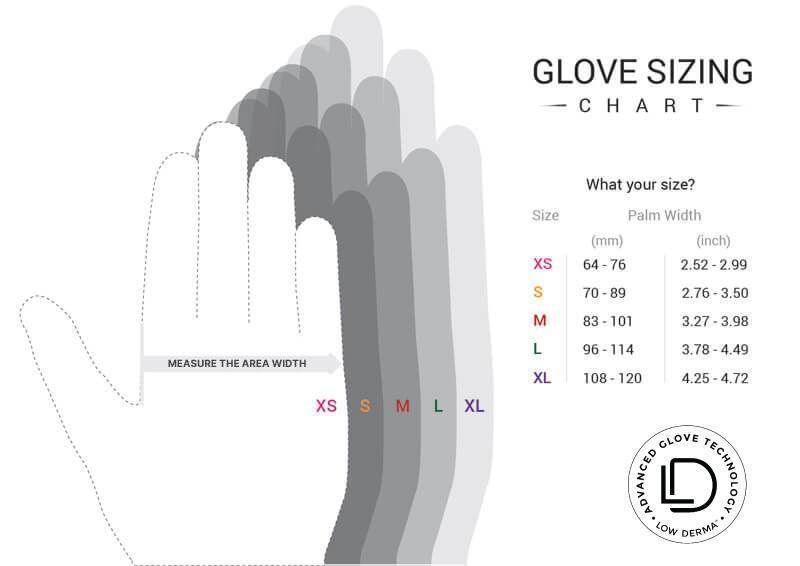
Select The Correct Glove Size